

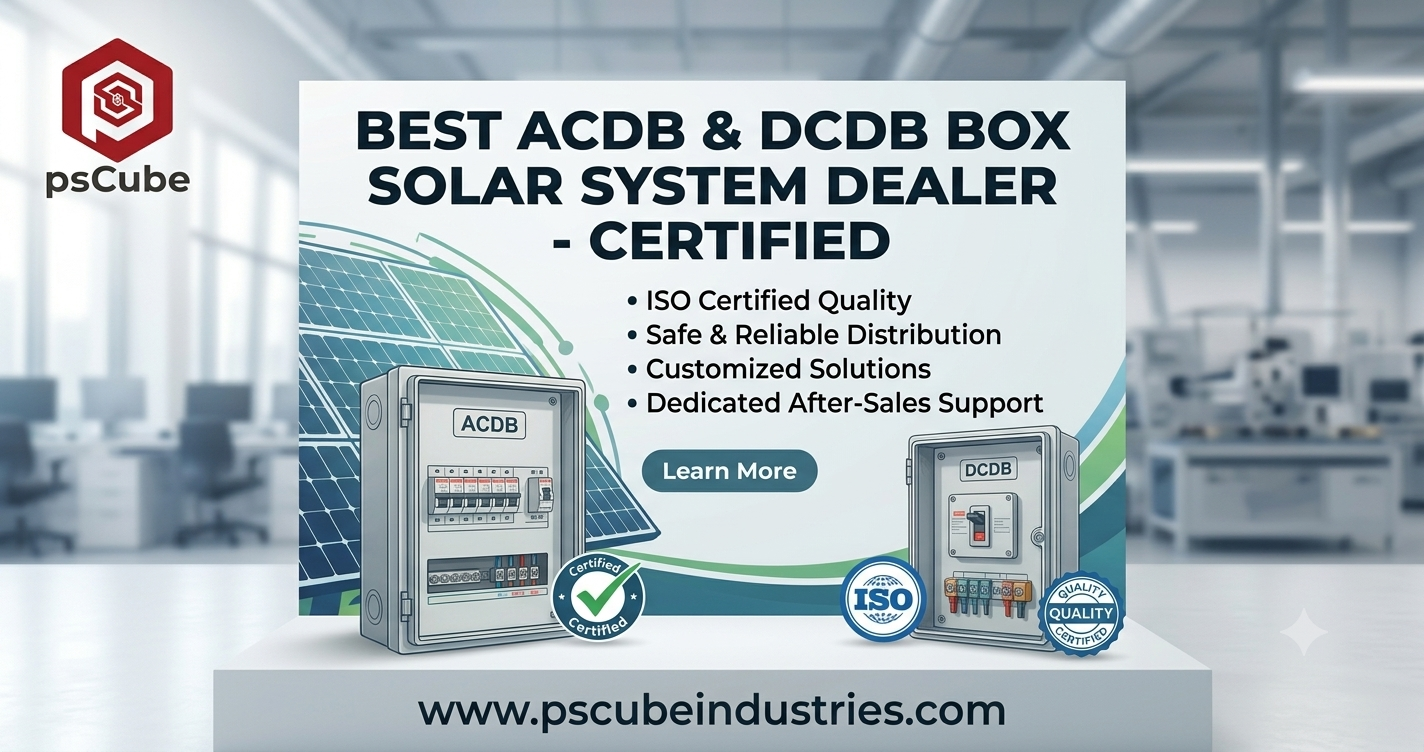
Built for the Reliable Future
Article Summary
- Understand exactly what an ACDB box and DCDB box do inside a solar PV system.
- Learn why skipping these components can destroy expensive inverters and panels.
- Explore the technical specifications, IP ratings, and compliance standards that separate reliable boxes from risky ones.
- Discover why PS Cube Industries is the most trusted ACDB box and DCDB box solar system dealer in India for residential, commercial, and industrial projects.
- Use our detailed comparison tables to choose the right configuration for your system size.
India added over 24 GW of solar capacity in 2025 alone, and 2026 is tracking even higher. Rooftop systems are being installed across homes, factories, hospitals, and government buildings at a pace the country has never seen before. Yet in the middle of all this growth, one quiet problem keeps showing up on job sites and service reports: solar systems that fail early – not because of bad panels or inverters, but because of a missing or low-quality ACDB box or DCDB box.
These two small enclosures are the unsung guardians of every solar power plant. Without them, a single voltage spike from a storm, a grid disturbance, or a panel mismatch can take out an inverter worth tens of thousands of rupees sometimes within the first monsoon season. Choosing the right ACDB box or DCDB box solar system dealer is therefore not a minor purchasing decision. It is a decision that protects your entire solar investment for the next 25 years.
This guide explains everything you need to know — from first principles to final installation – and shows you exactly why PS Cube Industries stands apart as India’s certified, reliable choice for solar distribution boxes in 2026.
What is an ACDB Box in a Solar System?
ACDB stands for AC Distribution Box, sometimes also called an AC Distribution Board or AC Combiner Box. It is installed after the solar inverter and before the connected electrical loads meaning it sits on the alternating current side of your system.
Its core job is threefold: it distributes AC power from the inverter to multiple load circuits, it protects the system from overloads and short circuits using Miniature Circuit Breakers (MCBs) or Moulded Case Circuit Breakers (MCCBs), and it guards against voltage surges using an AC Surge Protection Device (SPD). In large grid-tied plants where several inverters feed into a common bus, the ACDB also includes energy meters, isolation switches, and change-over switches that can seamlessly shift the connected load to the utility grid during emergencies.
💡Quick Fact: A properly specified ACDB box with a Type-2 SPD can absorb surge currents of up to 40 kA, preventing that energy from ever reaching your appliances or inverter output stage.
What is a DCDB Box in a Solar System?
DCDB stands for DC Distribution Box, also known widely as an Array Junction Box (AJB) or Solar String Combiner Box. It lives on the direct current side of your system — positioned between the solar panels and the solar inverter.
When multiple strings of solar panels generate DC power simultaneously, the DCDB collects all those individual string outputs, combines them safely, and passes the consolidated DC current to the inverter. Inside the box, DC fuses protect each individual string, a DC MCB isolates the entire array from the inverter when needed, and a DC Surge Protection Device (SPD) clamps any transient overvoltages that might travel back from the panels during lightning events or grid faults.
A key distinction that many buyers overlook: DCDBs come in two voltage classes — 600V rated for smaller residential systems (typically 1 kW to 9 kW) and 1000V rated for larger commercial and industrial installations (10 kW and above). Using a 600V-rated box on a 1000V string is a serious safety hazard and a compliance failure.
How ACDB and DCDB Work Together in a Solar PV System
To appreciate why both boxes matter, picture the complete power flow of a grid-tied rooftop solar system:
Solar Panels → DCDB Box → Solar Inverter → ACDB Box → Load / Grid
The DCDB box sits at the entry point of your system, collecting raw DC power from the panels and protecting everything downstream. The inverter converts that DC into usable AC power. Then the ACDB box takes over, managing how that AC power reaches your home circuits or commercial machinery — and ensuring that any disturbance from the load side never travels back to damage the inverter.
Remove either box, and you have an unguarded junction where a single fault can cascade into total system failure. This is why every reputable solar EPC contractor, every DISCOM interconnection guideline, and the Bureau of Energy Efficiency (BEE) all list both ACDB and DCDB as mandatory components of a properly installed solar plant.
Surge Protection SPD clamps transients before they reach electronics
Isolation Safety MCB/MCCB isolates faults without manual intervention
IP65 Weather Seal Dust and jet-water resistance for outdoor mounting
Energy Metering ISI-grade meter tracks generation at ACDB level
Change-Over Seamless switch to grid power during plant downtime
IEC Compliance Conforms to IEC 60947 and IEC 61439 standards
ACDB Box vs DCDB Box: Side-by-Side Technical Comparison
| Position in System | After the solar inverter, before the load | After solar panels, before the inverter |
| Current Type Handled | Alternating Current (AC) | Direct Current (DC) |
| Primary Protection Device | AC MCB / MCCB | DC MCB + DC Fuse per string |
| Surge Protection Device | AC SPD (Type-2, 40 kA discharge) | DC SPD (600V or 1000V rated) |
| Voltage Rating | 230V / 415V (single or three phase) | 600V (residential) / 1000V (commercial) |
| Operating Temperature | -25°C to +60°C | -25°C to +60°C |
| Enclosure Protection Rating | IP54 (indoor) / IP65 (outdoor) | IP65 (standard) / IP67 (harsh environments) |
| Additional Features | Energy meter, change-over switch, isolator | MC4 connectors, string monitoring, DC glands |
| Applicable Standards | IEC 60947-1/2/3, IEC 61439 | IEC 60947-1/2/3, IEC 61730, IEC 62548 |
| Typical System Size | 1 kW to 10 MW+ | 1 kW to 10 MW+ |
Why Choosing the Right ACDB Box and DCDB Box Solar System Dealer Matters
Walk through any solar marketplace online and you will find ACDB and DCDB boxes at a bewildering range of price points and quality levels. Some enclosures carry no IP rating stamp. Some SPDs are counterfeit or under-rated. Some MCBs are not DC-rated at all, a dangerous substitution that creates an arc flash risk that regular AC MCBs simply cannot interrupt on the DC side.
A certified and reliable dealer changes this equation entirely. Here is what separates a trustworthy ACDB box and DCDB box solar system dealer from a low-cost reseller:
- Components sourced from Tier-1 brands conforming to IEC and BIS standards — not unbranded imports.
- Enclosures that carry verifiable IP65 certificates from accredited labs, not just printed labels.
- DC MCBs and DC fuses that are genuinely rated for the DC voltage in use — not repurposed AC-rated components.
- SPDs with proven discharge ratings verified by CPRI or equivalent test reports.
- Clear documentation: wiring diagrams, test certificates, warranty cards, and compliance declarations, all supplied with every unit.
- Technical support that can specify the right box configuration for your inverter model and string arrangement, not just sell you a catalogue item.
- Post-installation service and warranty fulfilment that does not vanish after the invoice is paid.
PS Cube Industries: India’s Certified & Reliable ACDB Box and DCDB Box Solar System Dealer
PS Cube Industries has earned its position as one of India’s most trusted names in solar distribution box supply through consistent quality, technical depth, and a dealer philosophy built entirely around customer success rather than catalogue volume.
At PS Cube Industries, every ACDB box and DCDB box that leaves the facility has gone through a documented quality process — from component sourcing and assembly to final electrical testing before dispatch. The company does not treat these boxes as commodity hardware. Instead, each product is engineered as a safety-critical component that must perform flawlessly across 25 years of solar plant operation, through monsoons, summer heat waves, industrial vibration, and everything India’s climate can deliver.
What Makes PS Cube Industries Different
Genuine IP65 Outdoor Enclosures
Every outdoor DCDB and ACDB box supplied by PS Cube Industries uses enclosures that have been independently tested for IP65 ingress protection — meaning complete dust-tightness and resistance to water jets from any direction. This matters enormously for rooftop and ground-mount installations exposed to monsoon rain and construction dust.
CPRI-Tested and IEC-Compliant Components
The MCBs, MCCBs, SPDs, fuses, and busbars inside every PS Cube Industries distribution box conform to IEC 60947 parts I, II, and III, as well as IS 60947. The company works exclusively with brands and component grades that carry CPRI (Central Power Research Institute) approval — the gold standard for electrical safety testing in India.
Genuine DC-Rated Protection on the DC Side
This is where many low-cost suppliers get it dangerously wrong. PS Cube Industries uses only genuine DC MCBs and DC-rated fuses inside DCDB boxes. These components are specifically engineered to extinguish DC arcs, something an AC-rated breaker cannot do reliably. In a DC fault scenario, this distinction is the difference between safe isolation and a fire.
Full Customisation for Every System Size
A 3 kW residential rooftop needs a very different DCDB configuration compared to a 500 kW industrial ground-mount plant. PS Cube Industries engineers work with EPCs, system integrators, and direct buyers to specify the exact number of string inputs, the correct SPD voltage class, the right enclosure size, and the appropriate cable entry gland positions — all before the box is assembled. This means zero rework on site and zero compliance failures at DISCOM inspection.
Transparent Documentation and Warranty
Every PS Cube Industries product ships with a complete documentation package: IP rating certificate, component test reports, wiring schematic, installation guide, and warranty card. This documentation is essential for DISCOM net metering approvals, MNRE subsidy claims, and corporate EPC audit trails.
Products Offered by PS Cube Industries
PS Cube Industries covers every tier of the solar distribution box market – from compact single-phase units for small rooftop systems to large, floor-standing three-phase panels for utility-scale and C&I projects.
PS Cube Industries Product Range at a Glance
| Single Phase ACDB | 1 kW – 5 kW | Single Phase | 230V AC | IP54 / IP65 | AC MCB, AC SPD Type-2, Isolator |
| Three Phase ACDB | 5 kW – 1 MW+ | Three Phase | 415V AC | IP65 | MCCB, AC SPD, Energy Meter, Change-Over Switch |
| DCDB 1-in-1-out (600V) | 1 kW – 5 kW | — | 600V DC | IP65 | DC MCB, DC Fuse, DC SPD Class II, MC4 Connectors |
| DCDB 2-in-2-out (600V) | 5 kW – 10 kW | — | 600V DC | IP65 | DC MCB, DC Fuse ×2, DC SPD, PVC Glands |
| DCDB 2-in-2-out (1000V) | 10 kW – 50 kW | — | 1000V DC | IP65 | 4-Pole 1000V MCB, 1000V SPD, DC Fuse, Monitoring Terminals |
| Multi-String DCDB (1000V) | 50 kW – 10 MW+ | — | 1000V DC | IP65 / IP67 | Per-String Fusing, Monitoring, CRCA Powder-Coated Enclosure |
| Combined ACDB+DCDB Panel | Any | Single / Three Phase | Custom | IP65 | Full AC + DC protection in one integrated panel |
Technical Standards Every ACDB & DCDB Box Must Meet in 2026
India’s solar sector has grown far more regulated since 2023, and rightfully so. MNRE guidelines, DISCOM interconnection norms, and international IEC standards collectively define a clear baseline that every ACDB box and DCDB box must meet before it is installed in a grid-tied system. Understanding these standards helps you verify whether any dealer — including the one you are evaluating – is actually delivering compliant equipment.
IEC 60947 – Low Voltage Switchgear
IEC 60947 Parts I, II, and III govern the circuit breakers, switches, and contactors used inside ACDB and DCDB boxes. Compliance with this standard ensures that the MCBs and MCCBs inside your distribution box will interrupt fault currents within the rated breaking capacity — and will not weld shut or fail to clear during a short circuit. Every component in a PS Cube Industries box carries IEC 60947 and IS 60947 certification.
IEC 61439 – Low Voltage Switchgear and Control Gear Assemblies
This standard governs the assembled panel as a complete unit — not just the individual components inside. It specifies how the enclosure, busbars, wiring, and protective devices work together. IP65 certification for the full assembled box (not just the bare enclosure shell) falls under this standard. PS Cube Industries conducts final assembly verification against IEC 61439-1 requirements before dispatch.
IEC 62548 and IEC 61730 – PV System DC Side
IEC 62548 covers the design requirements for photovoltaic arrays, including DC wiring protection, string fusing requirements, and DCDB specifications. IEC 61730 addresses safety qualification of PV modules and their connection interfaces. Together, these standards define why your DCDB box must use DC-rated fuses, DC-rated MCBs, and SPDs specifically validated for DC voltage environments.
IP Rating – Why IP65 Is the Minimum for Outdoor Installation
The Ingress Protection (IP) rating describes how well an enclosure resists solid particles and water. IP54 is acceptable for indoor, sheltered installation. For any outdoor or semi-outdoor mounting which includes the vast majority of rooftop DCDB boxes and ground-mount installations IP65 is the minimum acceptable rating. IP65 means the enclosure is completely dust-tight and can withstand water projected in jets from any direction, making it suitable for direct rain exposure during India’s monsoon season.
Compliance Standards for Solar ACDB and DCDB Boxes in India – 2026 Reference
| IEC 60947-1/2/3 | Low voltage switchgear — general rules, circuit breakers, switches | MCB, MCCB, Isolators | Guarantees rated breaking capacity and safe fault isolation |
| IEC 61439-1 | Assembled low-voltage switchgear panels | Complete ACDB / DCDB Panel | Ensures the panel as a whole, not just its parts, is safe |
| IEC 62548 | PV array design and DC side protection | DCDB / Array Junction Box | Defines string fusing, MCB rating, and wiring protection rules |
| IEC 61730 | PV module safety qualification | DCDB MC4 connectors and interfaces | Ensures connection interfaces meet PV safety requirements |
| IP65 (IEC 60529) | Ingress protection — dust and water | Outdoor Enclosures | Mandatory for monsoon-safe installation; prevents corrosion and arcing |
| CPRI Approval | Indian national test certification for electrical components | MCBs, SPDs, Fuses | Required for DISCOM approvals and MNRE subsidy compliance in India |
| IS 60947 (BIS) | Indian standard equivalent of IEC 60947 | All switchgear components | Mandatory marking for sale of electrical goods in India |
5 Costly Mistakes Solar Buyers Make When Choosing an ACDB or DCDB Box
1. Buying on Price Alone Without Verifying IP Rating
The cheapest boxes on the market frequently use enclosures without verified IP ratings. When the monsoon hits, water infiltrates the box, causes a short circuit, and trips the inverter – or worse, starts an electrical fire. A verified IP65 certificate from an accredited lab is non-negotiable for any outdoor installation.
2. Using AC MCBs Inside a DCDB Box
This is perhaps the most dangerous substitution in low-cost solar boxes. AC circuit breakers are not designed to interrupt DC arcs. When a DC fault occurs, an AC breaker may fail to clear the arc, allowing it to burn continuously. Only genuinely DC-rated MCBs should ever be used on the DC side of a solar system.
3. Skipping the DCDB Entirely to Save Cost
Some installers still present DCDB boxes as optional. They are not. Without per-string fusing in the DCDB, a single reverse-current fault in one string can damage every other string connected to the same inverter MPPT input. The cost of replacing panels and inverter inputs dwarfs the cost of the DCDB many times over.
4. Selecting the Wrong Voltage Class
Installing a 600V-rated DCDB on a system with strings reaching 800V or 1000V is a compliance failure and a fire hazard. Always verify the maximum open-circuit string voltage of your panel configuration before selecting a DCDB voltage class. PS Cube Industries provides free technical guidance on this selection for every inquiry.
5. Ignoring Dealer After-Sales Support
Distribution boxes occasionally need replacement of SPDs (which are sacrificial components) or fuses after a surge event. If your dealer has no service infrastructure, getting genuine replacement components can become a months-long problem. PS Cube Industries maintains inventory of all replacement components and supports customers throughout the life of the system.
How to Select the Right ACDB and DCDB Box for Your Solar System
The configuration of your ACDB and DCDB box depends on four main variables: system capacity (in kW), number of inverters, number of panel strings, and whether the installation is indoor or outdoor. Use the guide below to identify the right starting specification for your system.
| 1 kW – 3 kW | Residential Rooftop | 1-in-1-out, 600V DC | Single Phase, 230V | IP54 (indoor) / IP65 (outdoor) | Home owner, small apartment |
| 3 kW – 10 kW | Residential / Small Commercial | 2-in-2-out, 600V DC | Single / Three Phase | IP65 | Villa, small office, clinic |
| 10 kW – 50 kW | Commercial Rooftop | 2-in-2-out or 4-in-4-out, 1000V DC | Three Phase, 415V, MCCB | IP65 | School, factory, hotel, shopping complex |
| 50 kW – 500 kW | Industrial / C&I Ground Mount | Multi-string, 1000V DC, per-string monitoring | Three Phase, MCCB + Energy Meter + Change-Over | IP65 floor-standing | Manufacturing plant, institution, EPC project |
| 500 kW – 10 MW+ | Utility Scale / Solar Farm | Custom multi-string combiner, 1000V DC | LT ACDB / ACCB panel, custom-engineered | IP65 / IP67 outdoor | Developer, IPP, government solar project |
Who Buys from PS Cube Industries — and Why They Keep Coming Back
Solar EPC Contractors
EPC companies face constant pressure on project margins and timelines. PS Cube Industries supports EPCs with bulk pricing tiers, pre-configured product lines that reduce specification time, complete documentation packages for DISCOM submissions, and on-time delivery reliability that keeps project commissioning on schedule. When a job site calls with a last-minute change to the string configuration, PS Cube Industries’ engineering team can turn around a revised DCDB specification the same day.
System Integrators and Distributors
Distributors who stock PS Cube Industries products benefit from consistent quality that generates zero returns from their own customers, a product range that covers residential through utility scale from a single supplier relationship, and brand credibility that helps close commercial sales to procurement committees and DISCOM officers who scrutinise component quality.
Residential and Commercial End-Users
Individual homeowners, housing societies, schools, hospitals, and factories buying solar systems directly can trust PS Cube Industries to supply ACDB and DCDB boxes that will satisfy their local DISCOM’s inspection requirements on the first visit — not after expensive re-work. The company’s technical team can also help end-users understand exactly what they should be receiving from their solar installer, preventing substitution of substandard components without their knowledge.
Government and Institutional Buyers
CPWD, state government energy departments, public sector undertakings, and educational institutions running solar procurement tenders require fully documented, standard-compliant components with traceable quality records. PS Cube Industries maintains the documentation depth that these procurement processes demand, including CPRI test reports, IP certificates, and compliance declarations that satisfy GeM (Government e-Marketplace) and tender audit requirements.
Ready to Source Certified ACDB & DCDB Boxes for Your Solar Project?
PS Cube Industries provides free technical consultation to help you choose the right configuration for your system – residential, commercial, or industrial. Contact us today and get a quotation within 24 hours.
📞 Get a Free Quote from PS Cube Industries
FAQs
1. Is a DCDB box mandatory for a rooftop solar system in India?
Yes. While some very small single-string systems may omit a separate DCDB box when the inverter includes built-in string protection, MNRE guidelines and most DISCOM interconnection norms require proper DC-side protection – either as a discrete DCDB/AJB box or as a documented built-in equivalent. For any multi-string system above 3 kW, a standalone DCDB with per-string fusing is strongly recommended by every reputable EPC contractor.
2. What is the difference between a DCDB box and an Array Junction Box (AJB)?
The terms are used interchangeably across the industry. Array Junction Box (AJB) is the older terminology common in large ground-mount project documentation, while DCDB (DC Distribution Box) is the more widely used term in rooftop and commercial projects. Functionally, both describe the same component: an enclosure that combines solar panel strings, provides per-string protection, and passes DC power to the inverter.
3. How often do SPDs in ACDB and DCDB boxes need replacement?
Surge Protection Devices are sacrificial – they absorb the energy of a surge event to protect the equipment behind them, and in doing so they can degrade or fail. In regions with frequent lightning activity or grid instability, SPDs should be inspected annually and replaced every 3–5 years, or immediately after any significant surge event. Most modern SPDs include a visual indicator (green = OK, red = replace) that simplifies inspection. PS Cube Industries stocks replacement SPDs for all boxes it supplies.
4. Can I use a single combined ACDB+DCDB panel instead of two separate boxes?
Yes, and in some compact installations this is a practical solution. PS Cube Industries manufactures combined ACDB+DCDB panels that integrate AC and DC protection in a single IP65 enclosure, reducing wall space and cable runs. However, for systems above 10 kW, separate boxes are generally preferred because the DC and AC sections require different enclosure volumes and the separate physical placement (DCDB near the array, ACDB near the inverter output) is more practical on larger plants.
5. What enclosure material is best for outdoor ACDB and DCDB boxes in India?
For harsh outdoor environments – rooftops, open ground mounts, coastal areas — UV-resistant polycarbonate enclosures or powder-coated CRCA (Cold Rolled Close Annealed) steel enclosures with 7-tank powder coating are the preferred choices. Polycarbonate is lighter and inherently rust-proof. CRCA steel with 7-tank processing is more robust against physical impact and is standard in industrial and utility-scale applications. PS Cube Industries offers both options depending on the installation environment and customer preference.
6. Does PS Cube Industries supply ACDB and DCDB boxes pan-India?
Yes. PS Cube Industries supplies its ACDB box and DCDB box products to solar EPCs, distributors, system integrators, and end-users across all states in India. The company has established logistics partnerships to ensure reliable delivery timelines even to Tier-2 and Tier-3 locations where solar deployment is currently growing fastest.
Conclusion: The Right Dealer Makes the Difference That Lasts 25 Years
Solar panels and inverters rightly get most of the attention when a system is being planned and sold. But it is the ACDB box and DCDB box, two components that often cost less than 2% of the total system price that determine whether the rest of the investment survives its first monsoon, its first grid fault, or its first decade of operation.
Cutting corners on these boxes is a gamble with odds that are simply not worth taking. The consequences of a failed distribution box range from nuisance tripping and lost generation to inverter replacement costs, fire damage, and failed DISCOM inspections that hold up net metering approvals for months.
Choosing PS Cube Industries as your ACDB box and DCDB box solar system dealer eliminates that gamble. You get IP65-certified enclosures, CPRI-approved components, genuine DC-rated protection on the DC side, complete compliance documentation, and the technical support of a team that understands solar systems from the panel string all the way to the grid connection point.
Whether you are installing a 2 kW rooftop system for a home in Rajasthan or commissioning a 5 MW ground-mount plant in Tamil Nadu, PS Cube Industries has the right product, the right documentation, and the right team to make your solar plant safe, compliant, and built to last.
Key Takeaway: An ACDB box and DCDB box together form the electrical immune system of your solar plant. Partner with a certified, reliable dealer who can supply components that meet IEC 60947, IEC 61439, IP65, and CPRI standards – and who will support you throughout the plant’s operational lifetime. That dealer is PS Cube Industries.
Follow us on – Facebook , Instagram , Youtube , Linkedin
You may also read: Solar Panel Supplier in Faridabad | Installation Ready