

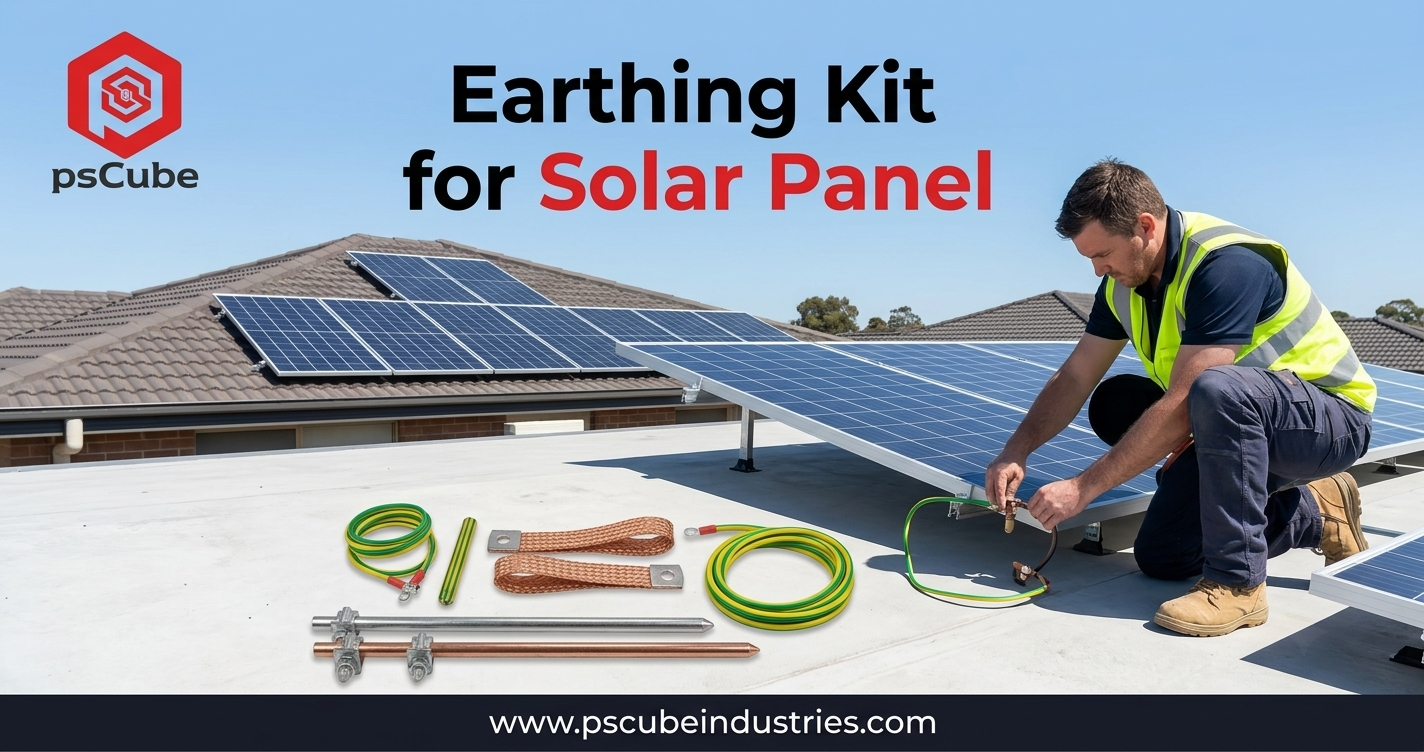
Solar power systems are built to last 25 years or more, but that lifespan depends on one component that rarely gets the attention it deserves: the earthing kit. Every year, thousands of rooftop and ground-mounted solar installations suffer avoidable damage from lightning strikes, electrical surges, and stray leakage currents simply because the earthing system was undersized, poorly installed, or ignored altogether.
An earthing kit for solar panel systems is not an optional accessory. It is a safety-critical component that protects human life, safeguards expensive equipment such as inverters and combiner boxes, and keeps your solar investment compliant with Indian electrical codes. This guide explains what a solar earthing kit is, how it works, which standards govern it, how to choose the right one, and how to install and maintain it correctly so you can make an informed decision whether you are a homeowner, installer, or EPC contractor.
What is an Earthing Kit for Solar Panels?
A solar earthing kit is a set of components earth electrodes (rods or plates), grounding wires, clamps, lugs, and connectors designed to create a low-resistance path between the metallic parts of a solar power system (panel frames, mounting structures, inverter bodies, combiner boxes) and the ground.
During normal operation, this path carries no current. But the moment a fault occurs a short circuit, an insulation failure, or a lightning strike the earthing kit instantly channels that stray or surge current safely into the earth instead of letting it travel through metal frames, cables, or, worse, a person standing nearby.
In simple terms, an earthing kit is your solar system’s safety net. Without it, even a well-designed solar array is one lightning storm or one wiring fault away from a serious accident.
Why Earthing Is Essential for Solar Systems
1. Protection from Electric Shock
Solar panel frames and mounting structures are made of aluminum or galvanized steel. If a live wire accidentally touches these metal parts, the entire structure can become electrically charged. A properly earthed system redirects this fault current into the ground before it can harm anyone touching the panel, structure, or nearby metalwork.
2. Lightning Protection
Rooftop and open-field solar installations are directly exposed to the sky, which makes them vulnerable to direct and induced lightning strikes. A dedicated lightning arrester connected through the earthing kit intercepts the surge and diverts it safely to earth, protecting panels, inverters, and connected home or factory wiring from catastrophic damage.
3. Equipment Longevity
Voltage spikes and leakage currents degrade sensitive electronics over time — even when they don’t cause an immediate failure. Consistent, low-resistance earthing reduces electromagnetic interference and stabilizes the system, which extends the working life of inverters, DCDB/ACDB units, and monitoring equipment.
4. Regulatory and Insurance Compliance
In India, earthing for electrical and solar installations must comply with IS 3043:2018 (Code of Practice for Earthing), along with guidelines from the Central Electricity Authority (CEA) and state discom requirements for net-metered rooftop systems. Non-compliant systems can face rejection during inspection, delayed subsidy disbursement, or insurance claim denial in the event of fire or storm damage.
5. System Efficiency
A stable earth reference reduces electrical noise on DC and AC lines, which can marginally improve inverter performance and reduce nuisance tripping caused by leakage current detection in RCDs/ELCBs.
How Does a Solar Earthing Kit Work?
- Electrode Installation – Copper-bonded, galvanized iron (GI), or pure copper rods/plates are driven or buried into the ground at a depth sufficient to reach permanently moist soil layers (typically 2.5-3 metres or deeper, depending on soil resistivity).
- Conductor Connection – Earthing wires or strips connect the electrode to a common earth bus bar.
- Bonding to Equipment – Grounding lugs and clamps bond the panel frames, mounting rails, inverter chassis, and combiner boxes to this earth bus bar.
- Soil Treatment (Optional but Recommended) – Backfill compounds like charcoal, salt, or bentonite-based conducting compounds reduce soil resistivity and stabilize resistance values across seasons.
- Fault Dissipation – When a fault or lightning surge occurs, this entire network provides a continuous, low-resistance path so current flows harmlessly into the earth instead of through equipment or people.
Types of Solar Earthing Kits
Not every installation needs the same earthing solution. The right choice depends on soil type, system size, and site conditions.
| Earthing Kit Type | Description | Best Suited For |
| Pipe/Rod Earthing | Galvanized iron or copper-bonded rod driven vertically into the ground | Residential rooftop systems, standard soil conditions |
| Plate Earthing | Copper or GI plate buried horizontally with charcoal/salt backfill | Areas with limited vertical soil depth |
| Chemical (Maintenance-Free) Earthing | Electrode filled with conductive, moisture-retaining chemical compound | Rocky, sandy, or high-resistivity soil; low-maintenance requirement |
| Strip/Grid Earthing | Interconnected copper or GI strips forming a mesh, often used with multiple electrodes | Large ground-mounted solar farms, commercial & industrial plants |
For most residential and small commercial rooftop systems, a rod or chemical earthing kit is sufficient. Utility-scale ground-mounted plants typically use a combination of strip/grid earthing with multiple interconnected electrodes to meet touch and step voltage safety limits.
Key Components of a Solar Panel Earthing Kit
| Component | Function |
| Earth Electrode (Rod/Plate) | Provides the primary contact point that disperses fault current into the soil |
| Lightning Arrester (LA) | Intercepts direct lightning strikes and diverts the surge to earth |
| Earthing/Grounding Wire or Strip | Carries fault current from equipment to the earth electrode |
| Grounding Lugs & Clamps | Bond panel frames, mounting rails, and inverter bodies to the earthing conductor |
| Mounting Base & Fasteners | Secures the electrode assembly and ensures a mechanically strong connection |
| Backfill Compound (Charcoal/Salt/Chemical) | Reduces soil resistivity around the electrode for a stable, low resistance value |
| Earth Bus Bar / Terminal | Centralizes multiple earth connections at a single, testable point |
A complete earthing kit bundles most of these components together, which simplifies procurement and ensures compatibility between parts, something that matters more than it might seem, since mismatched materials (for example, copper touching untreated GI) can cause galvanic corrosion over time.
Indian Standards & Compliance for Solar Earthing
Earthing for solar installations in India is governed primarily by IS 3043:2018, along with CEA regulations and BIS guidelines for module and system certification. Rather than fixing a single universal resistance value, these standards focus on touch voltage, step voltage, and fault-loop impedance to ensure genuine safety outcomes.
| Parameter | Typical Requirement / Guidance |
| Governing Standard | IS 3043:2018 – Code of Practice for Earthing |
| Practical Earth Resistance Target | Generally recommended to be 1 ohm or lower for a common/combined earthing system, though IS 3043 allows higher values (5–50 ohms) for individual electrodes depending on application |
| Lightning Arrester Specification | Copper rod, typically 1.2-1.5 metres in height |
| Earthing Conductor Sizing | Commonly 16 sq.mm for both DC and AC earthing runs in rooftop systems (project-specific sizing should follow a qualified electrical design) |
| Testing Frequency | Earth resistance should be tested every 6–12 months, and after major storms or soil disturbance |
| Connection Method | Earth strips must be welded/bonded at joints; bolted-only connections are generally discouraged for critical earthing runs |
Important note: Actual conductor sizing, electrode depth, and resistance targets should always be finalized by a qualified electrical designer based on site soil resistivity testing and the specific capacity of your solar plant. The values above are general industry guidance, not a substitute for a site-specific earthing design.
How to Choose the Right Earthing Kit for Your Solar System
Selecting the correct earthing kit isn’t a one-size-fits-all decision. Consider the following factors:
- System Size: A 3kW rooftop system has very different earthing requirements than a 1MW ground-mounted plant.
- Soil Type: Sandy or rocky soil has high resistivity and often needs chemical earthing or additional electrodes; loamy, moist soil generally performs better with standard rod earthing.
- Climate: Regions with high lightning frequency need a properly rated lightning arrester as part of the kit, not just basic equipment earthing.
- Material Quality: Copper-bonded and stainless-steel components resist corrosion far better than plain GI in humid or coastal environments, translating directly into a longer service life.
- Compliance Needs: Government and net-metering projects often require documentation proving IS 3043 and CEA compliance — choose a supplier who can provide test certificates and technical datasheets.
- Ease of Maintenance: Chemical earthing kits reduce the need for frequent watering and soil treatment, which matters for remote or hard-to-access installations.
Installation Best Practices
- Conduct a soil resistivity test before finalizing electrode type and depth.
- Keep the earthing conductor running as short and straight as possible to minimize resistance.
- Ensure all metallic components – module frames, mounting rails, inverter enclosures, and combiner boxes – are individually bonded to the earthing system, not just the main structure.
- Use corrosion-resistant hardware (stainless steel or hot-dip galvanized) at every connection point.
- Separate lightning protection earthing from power system earthing where required, or bond them correctly as per project design, to avoid interference.
- Always engage a licensed electrical contractor for final connections and testing, particularly for commercial and utility-scale installations.
Maintenance Tips to Keep Your Earthing System Effective
| Maintenance Activity | Recommended Frequency |
| Earth resistance testing | Every 6–12 months |
| Visual inspection of connections for corrosion/looseness | Every 6 months |
| Soil moisture check (for conventional rod/plate earthing) | Seasonally, especially before summer |
| Re-treatment of soil (charcoal/salt/chemical top-up) | As needed, based on resistance test results |
| Tightening of clamps and lugs | Annually, or after any major storm |
| Replacement of corroded electrodes or wires | As identified during inspection |
Skipping these checks is one of the most common reasons earthing systems fail silently — the system may appear to work until the exact moment it’s needed most, during a fault or lightning event.
Common Mistakes to Avoid
- Using undersized conductors to save on upfront material cost, which increases resistance and reduces fault-clearing effectiveness.
- Relying only on bolted connections for critical earth strip joints instead of welded or properly crimped connections.
- Ignoring soil resistivity and installing a standard rod kit in high-resistivity rocky or sandy soil without additional treatment.
- Skipping annual testing, assuming that because the system was compliant at installation, it will remain so indefinitely — resistance values can rise as soil dries out or electrodes corrode.
- Mixing incompatible metals (e.g., copper and untreated GI) without proper bimetallic connectors, leading to galvanic corrosion at joints.
Why Choose Ps Cube Industries for Your Earthing Kit Needs
Ps Cube Industries designs and supplies solar earthing kits engineered for real Indian site conditions from humid coastal regions to dry, high-resistivity soils. Every kit is built around the core principle that safety components should never be an afterthought in a solar project.
What sets Ps Cube Industries apart:
- Component Compatibility: Electrodes, conductors, and clamps are matched to prevent galvanic corrosion and ensure a consistent, low-resistance path over the life of the system.
- Standards-Aligned Manufacturing: Products are designed with IS 3043 principles in mind, supporting easier compliance for rooftop and commercial solar projects.
- Corrosion-Resistant Materials: Copper-bonded and galvanized components are selected for long-term durability across diverse Indian climates.
- End-to-End Solar Accessories: Beyond earthing kits, Ps Cube Industries supplies a wider range of solar mounting and balance-of-system components, making it easier for installers and EPC companies to source compatible, quality-tested parts from a single, reliable manufacturer.
- Decades of Manufacturing Experience: Backed by a leadership team with over 50 years of combined industry experience, Ps Cube Industries has built long-term trust with residential, commercial, and industrial solar customers across India.
Whether you’re a homeowner installing your first rooftop system or an EPC contractor managing a multi-megawatt project, Ps Cube Industries offers earthing solutions built for genuine field performance, not just a checkbox on a specification sheet.
(FAQs)
Q1. Is an earthing kit compulsory for solar panel installation in India?
Yes. Proper earthing is a mandatory safety requirement under Indian electrical codes and is typically checked during net-metering inspection and system commissioning.
Q2. What is the difference between equipment earthing and lightning protection earthing?
Equipment earthing protects against internal electrical faults (like insulation failure), while lightning protection earthing specifically handles high-energy surges from direct or nearby lightning strikes. A complete solar earthing kit generally addresses both.
Q3. How often should a solar earthing system be tested?
Earth resistance should be tested at least once every 6 to 12 months, and additionally after major storms, soil disturbance, or any visible corrosion at connection points.
Q4. Which type of earthing is best for rocky or sandy soil?
Chemical (maintenance-free) earthing generally performs better in high-resistivity rocky or sandy soil compared to standard rod or plate earthing, since it retains moisture and conductivity more effectively.
Q5. Can I install a solar earthing kit myself?
Basic components can be assembled by trained personnel, but final connections, resistance testing, and compliance verification should always be carried out or supervised by a licensed electrician, especially for grid-connected systems.
Summary
An earthing kit for solar panel systems is a foundational safety component, not an optional add-on. It protects people from electric shock, shields expensive inverters and panels from lightning-induced damage, extends equipment lifespan, and keeps your installation compliant with IS 3043 and related Indian standards. The right kit depends on your system size, soil conditions, and climate with options ranging from standard rod and plate earthing to chemical and strip/grid systems for larger installations. Regular testing and maintenance are just as important as correct initial installation, since earth resistance can change over time due to soil conditions and corrosion.
Conclusion
Solar panels are often marketed on efficiency, wattage, and warranty — but none of that matters if the underlying safety infrastructure is compromised. A well-designed, correctly installed, and regularly maintained earthing kit is what stands between your solar investment and a preventable disaster during a lightning storm or electrical fault. Choosing a trusted, standards-aware manufacturer like Ps Cube Industries ensures that this critical component receives the same attention to quality as the panels and inverters it protects — because a solar system is only as safe as its weakest connection to the ground.
About the Author
This article has been reviewed and published by the team at Ps Cube Industries, under the guidance of company owners Shashi & Pooja, who bring together more than 50 years of combined experience in the solar mounting and balance-of-system manufacturing industry. Ps Cube Industries has proudly served over 2 lakh satisfied customers across India and offers a growing portfolio of 20+ solar accessory products, including earthing kits, mounting structures, and related components all engineered for durability, safety, and real-world performance.
Contact Ps Cube Industries
📍 Address: B 115, First Floor, Green Field Colony, Mathura Road, Faridabad – 121003, Haryana, India 📧 Email: info@pscubeindustries.com 📞 Phone: +91-8800911098, +91-7011956266
For technical guidance on selecting the right earthing kit for your solar project, reach out to the Ps Cube Industries team directly.